

by FTR | Thought Leadership, on May 05, 2026

In last month’s discussion of the concerns that we have over the scope and durability of freight demand, we noted that one of the exceptions was construction of data centers, which is growing strongly. Another is the construction of manufacturing facilities for computer-related goods, which is nearly two years past its peak but still strong relative to most nonresidential construction sectors. We also pointed out that computer-related goods – a major share of which is software – and pharmaceuticals were big drivers of spending growth with limited impact on freight.
Our focus last month was on the complexity surrounding the economic drivers of freight demand, and that happened to touch on computers and artificial intelligence. This month, we are pivoting to look at AI’s impact on other economic indicators besides data center construction and consumer spending.
Technically, we can’t prove that all the metrics discussed below are driven by the AI phenomenon. However, it’s unlikely that such enormous investments in a short period of time are due to any other factor than AI and the data centers to support it. To be clear, though, demand inelasticity due to the high priority of completing these projects is driving up pricing and distorting nominal data. However, but that dynamic mostly reinforces the outsized impact that AI investment is having on the economy.
Revisiting Data Centers
As noted earlier in this report, the 2026 forecast for flatbed truck loadings has improved to a 3.2% y/y, which would be the strongest growth since 2017. The prior forecast was +1.9%. Only one commodity group contributed to that improvement: Building materials. We currently are forecasting construction loadings for flatbed to rise 5.0% y/y, up from 1.0% previously.
Monthly truck volume forecasts can be volatile, so there’s no guarantee that this improved forecast will hold. However, data center construction does appear to be a significant driver of flatbed activity, and there’s no sign yet of a peak in that construction.
Also, there has been some improvement in residential construction very recently and in manufacturing for a number of months, but neither – separately or combined – seems robust enough to explain the extraordinary levels of load activity in the spot market as reflected in metrics from Truckstop.com. (See page 7 for details on flatbed spot volume.) On the other hand, capacity apparently is so tight in the long-haul specialized trucking sectors that it would not take that much improvement in freight volume to send spot metrics soaring.
Among the 10 largest private construction sectors – either residential or nonresidential – based on the value of projects put in place in 2025, data centers were the overwhelming leader, jumping 32% y/y. Next was construction of chemicals manufacturing facilities, up 9.4% – likely driven by the pharmaceuticals. Third was electric power facilities, up 3.4% no doubt due – in part, at least – to the power needs of data centers. The only other construction sector to post any gain at all was residential improvements, up 0.8%.
This is nominal data, so growth in spending residential improvements and possibly even on electric power construction might simply be a function of pricing. While pricing might have puffed up the y/y comparison for data centers, too, pricing surely cannot account for a 32% increase in a single year.
A Matter of Some Imports
Since the advent of tariffs – and the threat of tariffs – more than a year ago, several commodities have skewed data on international trade in goods. Gold and pharmaceuticals have greatly distorted imports mostly but also exports, especially in the case of gold. One other commodity group has greatly changed the view of imports of capital goods, but in that case, it’s not because of tariffs. It’s because of AI, we presume.
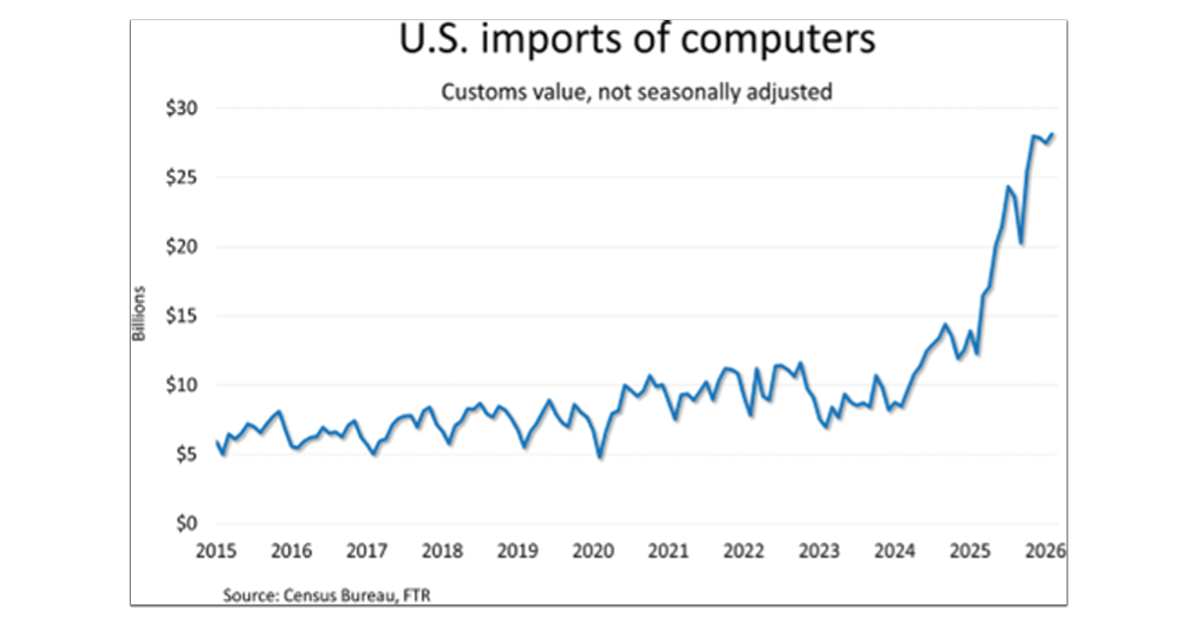
Computer-related imports began to move notably higher in late 2024, but those imports last year and into this year really took off. As of the latest data available, February 2026 is the peak, although imports for November 2025 through February are in the same basic range.
In February, advance data shows imports of capital goods at an all-time high, and that’s true whether you adjust for inflation or not. In 2025, capital goods rose 17.2% y/y nominally. However, computer imports surged 79.0%.
Excluding computers, capital goods imports were still up but by a more pedestrian 6.7% that isn’t that much stronger than the 4.3% nominal increase in all imports in 2025.
Getting Electronics Wholesale
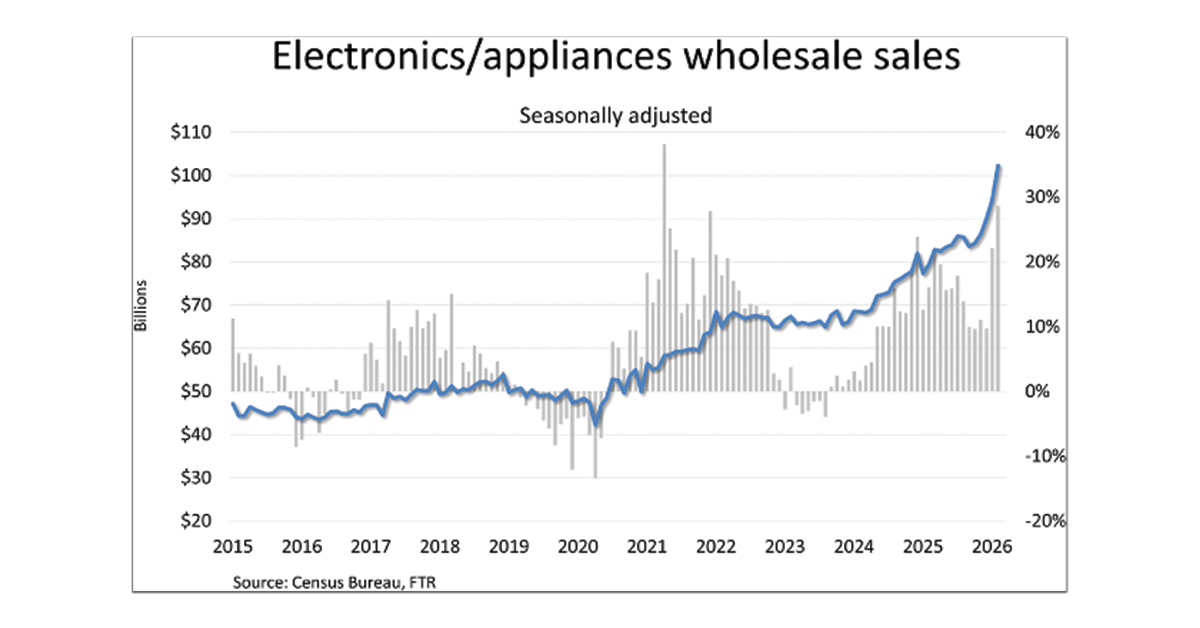
Inventories in the wholesale sector have moved sharply lower relative to sales recently, and the principal driver by far has been demand for goods in the category known as “household appliances and electrical and electronic goods.” Given the state of the housing market, we can presume that washing machines and refrigerators that are not moving this category.
Wholesale sector sales for electronic goods and appliances have been running more than 10% higher y/y almost without exception since May 2024. The three months that failed to achieve that threshold all recorded y/y comparisons of more than 9.5%. The m/m gains have been especially strong over the past four months, and sales in February – the latest month for which data is available – were up nearly 29% y/y.
Although inventories have been rising in recent months, sales growth has far outpaced inventory growth to the point where the inventories-to-sales ratio was at an all-time low of just 0.88 in February.
Soaring Manufacturing Demand
As we discussed last month – and noted briefly above – construction of manufacturing facilities specifically for computers and electronics dominated spending on nonresidential construction staring around the middle of 2022. That extraordinary investment peaked in 2024 but is still high relative to most other broad sectors of nonresidential construction. By early this year, the value of computer and electronics manufacturing facilities put in place per month was roughly the same as the value of data centers being completed.
That surge in construction was underwritten by several federal legislation in 2021 and 2022. The investment certainly created lots of construction jobs as well as jobs in trucking, but obviously construction jobs were not the objective. Rather, the goal was to produce more computer and electronic products domestically and to be less dependent on foreign sources of key components as had been the case with semiconductors in 2021 and 2022.
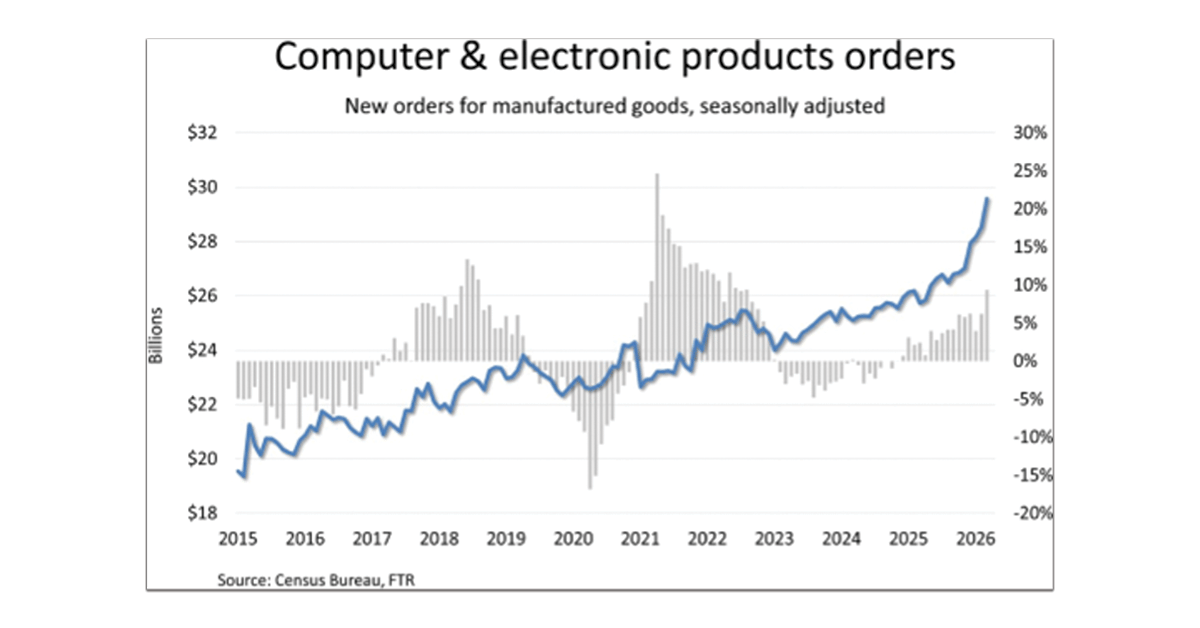
That investment clearly has begun to pay off. New orders for domestically manufactured computer and electronic products have been rising since early 2023, but they have really taken off over the past four months. In March, new orders were up 15% y/y – the strongest prior-year comparison since 2006. Again, pricing probably is a substantial contributor, but that doesn’t negate the fact that demand has strengthened greatly.
In March, new orders for core capital goods – nondefense capital goods excluding aircraft – were up 9.4% y/y. However, if we further exclude computer and electronic products, new orders were up 6.5%.
Lots of Tea Leaves to Read
Having the AI phenomenon show up in so many places in economic data could help us assess when the infrastructure investment starts to peak out, which it inevitably will one day. Tracking data center construction likely would not be a leading indicator because project timelines are so long. Just what AI might mean long term for freight is a work in progress, but data center construction certainly is a near-term positive.
Like this kind of content? Subscribe to our "Food For Thought" eNewsletter!

Now more than ever, professionals consume info on the go. Distributed twice monthly, our "Food For Thought" e-newsletter allows readers to stay informed about timely and relevant industry topics and FSA news whether they're in the office or on the road. Topics range from capacity, rates and supply chain disruption to multimodal transportation strategy, leveraging technology, and talent management and retention. Learn More