

by GoodShip | Thought Leadership, on Jun 08, 2026
A growing number of transportation teams have turned network drift from a year-end surprise into something they manage in real time, and in today's market that's becoming a real competitive edge. Every network drifts the moment a bid closes. The routing guide you negotiate reflects a single snapshot in time. The carriers, rates, lane volumes, and service expectations are captured on bid day, but the network begins changing immediately. Carriers shift, lanes move, acceptance slips, costs creep. That gradual divergence between the network you designed and the one you're actually running is network drift, and for roughly three years it was easy to ignore.
Food and beverage shippers spent that stretch in one of the most favorable freight environments in recent memory. Carriers chased volume, rates trended down or held flat, and routing guides held together. Many transportation teams went into 2026 budget planning with cost-reduction targets, or at worst, flat year-over-year assumptions. Now that window is closed. Tender rejections are creeping up, spot rates are moving, and the routing guides built in last year’s bid are starting to crack on exactly the lanes that matter most. The strategies that worked in a buyer's market don't all translate. When capacity was plentiful, the cost of drift stayed buried. However, now that it's tightening, what was once a rounding error is becoming a meaningful budget variance.
The good news is network drift is one of the few transportation costs you can catch and correct in real time. As the technology available to transportation teams has advanced, leading shippers have stopped treating the annual RFP as the only moment to get the network right, course-correcting as drift emerges instead. The reframe is simple but powerful: drift only stays a hidden cost if you wait to look for it.
The shippers who manage drift well tend to share one habit worth learning from: they treat the network as a living system that needs continuous care, not something to reset once a year. The annual bid produces a plan, but the eleven months that follow are where that plan is tested and where small gaps between intent and execution begin to open up. That discipline shows up in a few specific places. It shapes how quickly routing-guide decay gets caught, how often the network is reviewed, and which carriers are awarded volume. Underpinning all of it is a simpler question of whether a team can see its network clearly enough to act at all.
Routing-guide decay is a good example. Decay sets in when an awarded primary carrier gradually stops covering a lane the way the contract promised. A primary on a key DC lane might slip from 95% to 70% acceptance over a quarter, and freight rolls to a backup carrier running about 12% higher. Caught early, that decline is a minor adjustment; left unnoticed, the backup quietly becomes the lane's default, and the premium becomes a structural cost. The practical moves are straightforward. Set acceptance-rate thresholds per lane, flag rolldowns as they happen, and re-tender or renegotiate before freight routinely falls down the guide.
The leading edge of the industry is already moving this way. Across the GoodShip platform, the number of sourcing events launched jumped 124% in a recent 90-day window, with 85% of them mini-bids covering 25 lanes or fewer. Teams aren’t running bigger RFPs; they’re running smaller, more targeted mini-bids, more often, to catch decay on the specific lanes that are drifting rather than waiting for the whole network to come up for bid.
The reason that cadence matters is simple. A network examined once a year but changing every day will always run on stale assumptions. The cost of waiting hides in the lag between when a problem starts and when anyone notices, and that lag is expensive.
Closing the lag starts with deciding what to watch. Acceptance rates are one early signal of drift, but they aren’t the only one teams track. Many also watch a lane-level scorecard, a simple, regularly updated view of how each lane is actually performing against its plan across clear metrics: acceptance rate, on-time pickup, on-time delivery, and cost versus the award rate. Reviewed on a steady cadence rather than once a year, a scorecard surfaces problems while they’re still small. A transit time stretching by half a day shows up before it triggers an OTIF penalty at a retail customer and gets corrected immediately. The discipline is to define what “good” looks like for each lane up front, monitor against it continuously, and treat small variations as signals to act on rather than noise to absorb.
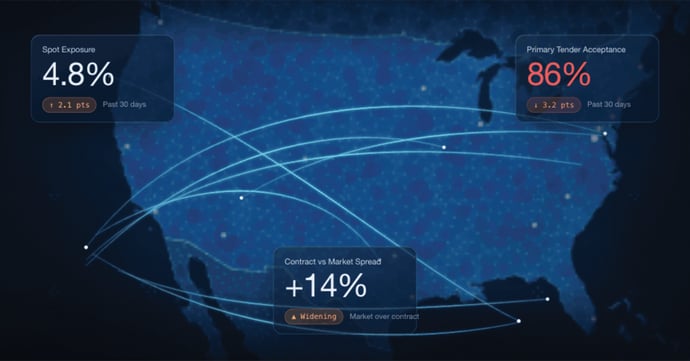
Where the scorecard tracks how individual lanes are executing, a second set of indicators tracks where cost exposure is building across the network as a whole. Watching the right early signals daily rather than at quarter-end is the difference between catching a problem at $50K and finding it at $500K, and the math scales fast. For a shipper with $100 million in annual truckload spend, a ten-percentage-point rise in spot exposure sustained over three months can equate to roughly $600,000 to $1 million or more in excess cost when spot rates run 25–40% above the contracted rate. A handful of indicators tend to move first and predict where overspend is building: tender rejection rate, spot exposure as a percentage of volume, lane volatility, and the spread between contract and market rates.
The honest challenge is that not every team can see these in real time. The numbers live in separate systems and only get assembled into a clear picture during the budget review or the run-up to the next bid by which point, the signal is months old and the cost is already booked.
The shippers who manage drift best have closed that gap by making these indicators visible day to day in the same platform, so a rising rejection rate or widening rate spread reads as an early warning rather than a year-end surprise. The advantage isn't access to more data. Most teams are sitting on all of it already. It's having that data surfaced soon enough to act while the problem is still small.
Cost is only one dimension of drift. The other is reliability. A lane can look like a win at award time yet turn into one of the network's quiet drains within a quarter.
The way to see through this is to put performance data next to cost. When acceptance rates, on-time pickup and delivery, and volume-against-commitment sit alongside the linehaul rate, the real ranking of carriers often looks different from the one the bid produced.
One large reefer shipper held spot-market exposure to roughly 1.5% of volume even as tender acceptance slipped into the 80s during the current tightening market — a result credited to disciplined, year-round carrier relationships rather than chasing the lowest rate at each bid. The lesson is to let reliability earn volume: use real performance data to shift freight toward the carriers who actually honor their commitments and let that track record carry weight in the next award.
Catching routing guide decay early, monitoring continuously, and rewarding reliability depends on the same foundation: the ability to see the network clearly enough to know where to act. And that is where most drift actually hides.
The deepest hidden cost is the lane you think is cheap. A low linehaul rate can mask heavy accessorials, frequent roll-downs, and a soft on-time record — and because rate, tender, and invoice data usually live in three separate systems, the true landed cost of that lane never appears in any one place. Teams end up defending a "good" lane that is quietly one of their most expensive. Pull those data sets into a single view, though, and the ranking often inverts: the lane that looked cheapest by rate lands near the top by total cost once accessorials and failed tenders are counted in.
This is the structural fix beneath all the others, bringing procurement and execution data together so decisions rest on the full picture rather than the rate sheet alone. Unifying the data solves the visibility problem, but it raises a practical one: no team can manually watch every lane, carrier, and accessorial line every day. This is where AI has started to change workflows.
Rather than waiting for an analyst to notice a trend, a model can monitor the unified data continuously and flag the variances that signal drift as they emerge:
Such variances include:
- Rejection rate ticking up on a key lane
- Accessorial creeping above its historical norm
- Contract-to-market spread widening past a threshold
The shift is subtle but important. Detection moves from periodic and manual to continuous and automatic, which means the warning arrives while the problem is still small. Platforms such as GoodShip now build this kind of AI-driven variance detection directly into the workflow, but the underlying principle matters more than any single tool. The closer monitoring gets to real time, the smaller and cheaper the average problem becomes.
Managing network drift well turns out to be less about any single decision than about how often transportation teams are willing to look. The teams that watch the right signals and act on drift while it's still small spend a tightening market making routine corrections, while those reviewing the network only at bid time spend it explaining variances after the fact. The difference isn't resources or leverage, it's cadence. Technology has made that cadence far easier to sustain, surfacing the signals that used to stay buried until quarter-end, but the real shift is one of mindset: treating the network as something to watch continuously, and drift as something to catch before it becomes expensive. That's within reach of any shipper willing to make it a priority.
Like this kind of content? Subscribe to our "Food For Thought" eNewsletter!

Now more than ever, professionals consume info on the go. Distributed twice monthly, our "Food For Thought" e-newsletter allows readers to stay informed about timely and relevant industry topics and FSA news whether they're in the office or on the road. Topics range from capacity, rates and supply chain disruption to multimodal transportation strategy, leveraging technology, and talent management and retention. Learn More