
by Staff, on Aug 11, 2026
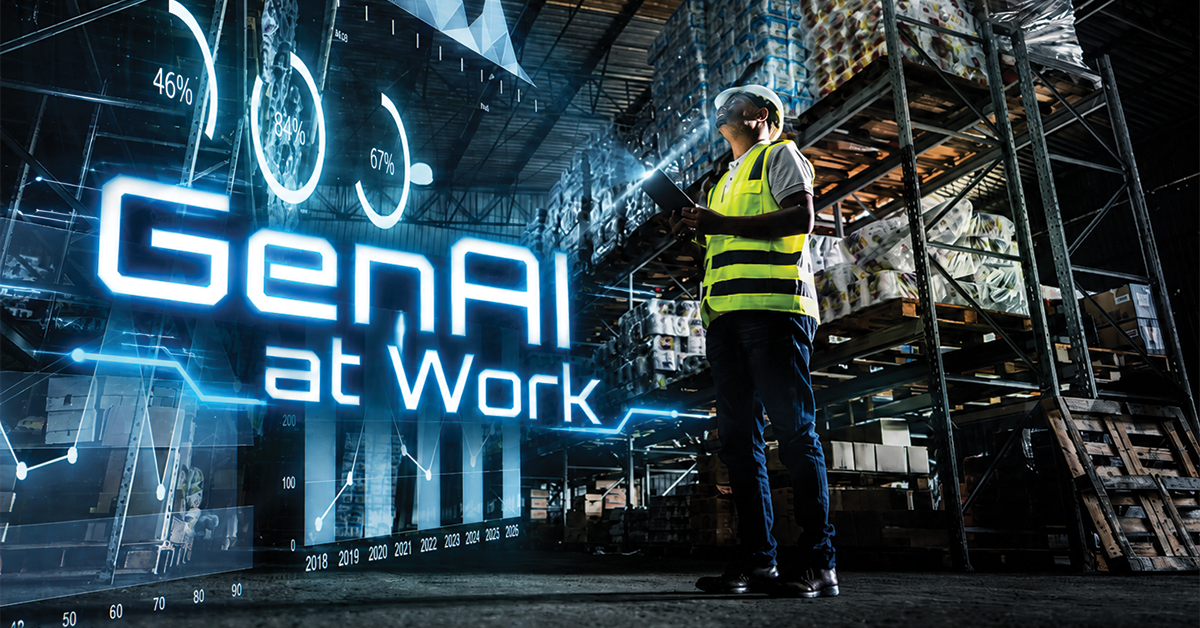
Food supply chains are balancing a delicate equation: how to deliver the right products to the right place at the right time while navigating perishability, fluctuating demand, labor shortages, transportation constraints, and rising customer expectations.
Today, Generative Artificial Intelligence (GenAI) is helping food shippers solve many of these challenges. Rather than replacing people, AI is augmenting human decision-making by analyzing significant amounts of data, identifying business patterns, and providing recommendations that help supply chain professionals make faster, more informed decisions.
Interestingly, while the benefits of its use and results can be significant there are mixed opinions on how much they want to tap into GenAI in their overall strategy and operations. In fact, Gartner recently surveyed 140 senior supply chain leaders on their AI strategies. The data showed that only 17% of supply chain organizations are pursuing immediate transformational redesign of their processes and workflows, while 83% are either applying AI incrementally to specific use cases or gradually scaling it into integrated processes.
Across the food industry, leading food brands such as Hormel Foods, PepsiCo and Nestlé are finding practical applications for AI that improve efficiency, reduce costs, strengthen supply chain visibility, and enhance overall customer service.
Improving Demand Forecasting
Traditional forecasting models often rely heavily on historical sales data. AI models can incorporate dozens of additional relevant variables, such as weather forecasts, promotions, holidays, economic factors, and social media trends, to predict future demand with greater accuracy.
More accurate forecasts help food manufacturers and distributors reduce stockouts, minimize excess inventory, lower spoilage and food waste, improve customer fill rates, and optimize production schedules.
For products with short shelf lives, even small improvements in forecast accuracy can translate into significant cost savings.
One of AI's greatest strengths is its ability to improve demand forecasting. One food shipper doing so is Hormel Foods, a global branded food company with over $12 billion in annual revenue and member of Food Shippers of America (FSA). The food manufacturer is leveraging AI and machine learning driven forecasting to model key demand drivers while expanding touchless forecasting capabilities to reduce manual overrides and improve forecast accuracy for seasonal demand.
The company is also leveraging an AI-powered digital platform to enable system-recommended inventory transfers and optimized truckload grouping based on weight, volume, and stackability constraints, strengthening coordination across the supply network. By translating demand signals into synchronized supply, inventory, and deployment decisions, planners can evaluate trade-offs earlier in the planning cycle, improving visibility and alignment across retail, foodservice, and international segments.
 “Every day, we balance moving thousands of products across multiple channels and storage environments,” says Will Bonifant, Chief Supply Chain Officer, at Hormel Foods. “By connecting demand, supply, and inventory decisions in one streamlined platform, we are shifting from reactive problem-solving to more proactive, data-driven planning. We believe this will strengthen our ability to operate consistently, serve customers more reliably, and ultimately, drive additional growth across our brand portfolio.”
Optimizing Transportation
Transportation represents one of the largest operating expenses in food supply chains. GenAI-powered transportation management systems (TMS) evaluate thousands of routing possibilities within seconds, considering factors such as traffic conditions, weather, fuel costs, delivery windows, driver availability, equipment utilization, and customer priorities.
These systems help companies reduce transportation costs while improving on-time delivery performance.
For example, PepsiCo recently announced a strategic, multi-year collaboration with Google Cloud to strengthen its digital foundation and leverage Gemini Enterprise Agent Platform to help teams move from insight to action more quickly and consistently at scale.
PepsiCo is now working with Google Cloud to transform its existing IT technology ecosystem and advance the company’s multi-cloud strategy. This partnership provides PepsiCo the flexibility to leverage the best available AI technology to address complex business challenges, such as supply chain management and go-to-market execution. By migrating to Google Cloud’s secure, global cloud infrastructure, PepsiCo will build new digital capabilities across its global operations.
 “As market dynamics and customer expectations evolve, PepsiCo is re-examining how we bring products to market and how we make decisions at scale,” says Athina Kanioura, CEO, Latin America Foods, and Chief Strategy & Transformation Officer, PepsiCo. “Google Cloud’s deep expertise in AI and engineering strengthens our best-in-class supply chain and go-to-market capabilities — giving us unprecedented speed and precision to model scenarios that were previously impossible to run. The result is faster decisions, improved frontline experiences, and a step change in how we design and operate our business.”
Through the collaboration, PepsiCo is using Gemini Enterprise Agent Platform to strengthen its foundational capabilities across three primary pillars:
- Scaling Global Intelligence: PepsiCo will utilize Google Cloud’s infrastructure to expand its data and analytics capabilities through an AI-driven digital platform, creating a resilient foundation for global operations and digital transformation.
- Optimizing the Value Chain: By applying Gemini’s advanced AI capabilities on Gemini Enterprise, PepsiCo will unlock faster, more informed decision-making – from long-term strategy to in-store execution – driving growth and productivity while improving cost efficiency.
- Empowering the Workforce: Capabilities from Gemini Enterprise will be embedded into AI-enabled workflows, helping PepsiCo associates reduce manual effort and surface insights faster. This shift allows employees to focus on the work that matters most while elevating the overall employee experience.
PepsiCo has invested heavily in AI to make its transportation network more efficient. Through its partnership with Google Cloud, the company is using AI to improve supply chain decision-making, enabling teams to model transportation scenarios more quickly and optimize how products move from manufacturing facilities to customers.
Strengthening Inventory Management, Enhancing Warehouse Operations
Maintaining the right inventory levels has become increasingly difficult amid changing consumer demand and ongoing supply chain uncertainty.
AI enables inventory managers to move beyond static safety stock calculations. Instead, intelligent systems continuously evaluate sales velocity, supplier performance, production capacity, lead times, transportation reliability, and seasonal demand. This allows companies to maintain service levels while reducing excess inventory and freeing working capital.
Warehouses are becoming increasingly intelligent through AI-enabled technologies. Machine learning algorithms help optimize slotting strategies, picking routes, labor scheduling, dock assignments and equipment utilization.
Computer vision systems can also assist with inventory counting, pallet inspections, and quality verification, reducing manual effort while improving accuracy. These capabilities enable distribution centers to process orders more efficiently while improving workplace safety and productivity.
One food manufacturer leveraging AI to strengthen inventory management and improve supply chain decision-making across its global operations is Nestlé, a member of FSA. According to the company, AI and Intelligent Process Automation (IPA) are being deployed at scale to automate demand forecasting and inform product distribution decisions. By anticipating stockouts, optimizing inventory, and providing greater real-time supply chain visibility, Nestlé is equipping planners with better data to make faster, more informed decisions. The company's long-term vision is a fully connected, end-to-end digital supply chain that uses AI to optimize inventory, automate processes, and improve operational efficiency.
Increasing Supply Chain Visibility
Modern food supply chains generate tremendous amounts of data across procurement, manufacturing, transportation, warehousing, and customer service. AI helps bring these data sources together into a unified view.
Supply chain leaders can quickly identify:
- Supplier risks
- Inventory shortages
- Transportation delays
- Capacity constraints
- Service issues
Instead of spending hours compiling reports, teams can focus on making decisions that keep products flowing to customers.
Other Supply Chain Benefits to AI
There are additional advantages to the use of AI. It is helping procurement teams strengthen supplier relationships. By analyzing supplier performance over time, organizations can identify trends in quality, delivery reliability, pricing, and responsiveness. These insights support better sourcing decisions, improve contract negotiations, and help companies proactively manage supply risks before they affect customers.
Despite widespread discussion about automation, the most successful AI implementations complement human expertise rather than replace it. Supply chain professionals remain essential for evaluating recommendations, managing customer relationships, responding to unexpected events, and making strategic decisions.
AI excels at processing large volumes of information and identifying patterns that humans might overlook. People provide the judgment, experience, creativity, and relationship-building skills that technology cannot replicate. The combination creates stronger, more agile supply chain organizations.
As AI technologies continue to mature, their impact on food supply chains will likely expand. Emerging applications include autonomous planning, digital twins that simulate supply chain scenarios, enhanced traceability, and increasingly sophisticated risk prediction capabilities.
For food companies, the question is no longer whether AI belongs in the supply chain — it is how to deploy it strategically to create measurable business value.
Related Articles:
- 70th Annual Food Shippers Conference: The Economy, Collaboration, AI, Fraud & Theft
- AI-Empowered: From Planning to Operations and Risk Management
- AI-Powered Automated Counting Creates Efficiencies
- Generative AI In Action
- Wendy’s Co-Op Leverages AI and Supply Chain Digitalization
Like this kind of content? Subscribe to our "Food For Thought" eNewsletter!
Now more than ever, professionals consume info on the go. Distributed twice monthly, our "Food For Thought" e-newsletter allows readers to stay informed about timely and relevant industry topics and FSA news whether they're in the office or on the road. Topics range from capacity, rates and supply chain disruption to multimodal transportation strategy, leveraging technology, and talent management and retention. Learn More