
by Staff, on Aug 11, 2026
Recent indicators point to a food and beverage manufacturing sector that is expanding, but doing so cautiously amid persistent cost pressures and supply chain uncertainty. The Institute for Supply Management's July Manufacturing PMI reached 55.6, its highest reading in more than four years, signaling broad manufacturing growth. Notably, the food and beverage industries are reporting expansion in production and employment, reflecting steady demand and improved factory activity.
At the same time, food and beverage manufacturers continue to navigate higher input costs, pandemic-era-like supply shortages and longer supplier lead times, and ongoing pricing volatility. In particular, they’re struggling to adapt to tariff and inflation pressures rather than viewing them as acute disruptions.
The Current State of Manufacturing
Overall, the manufacturing sector enters the second half of 2026 in a stronger position than a year ago, with production and hiring gaining momentum. However, profitability remains tied to manufacturers' ability to manage labor availability, ingredient costs, and supply chain resilience in an environment of continued economic uncertainty.
Economic activity in the manufacturing sector expanded in July for the seventh consecutive month, according to supply executives through the latest ISM® Manufacturing PMI® Report.
 The Manufacturing PMI® registered 55.6% in July, 2.3 percentage points above the June figure and the highest reading since May 2022 (55.9 percent), according to Susan Spence, Chair of the Institute for Supply Management® (ISM®) Manufacturing Business Survey Committee. The overall economy continued to expand for the 21st consecutive month.
A Manufacturing PMI® above 47.5%, over a period of time, generally indicates an expansion of the overall economy, she notes.
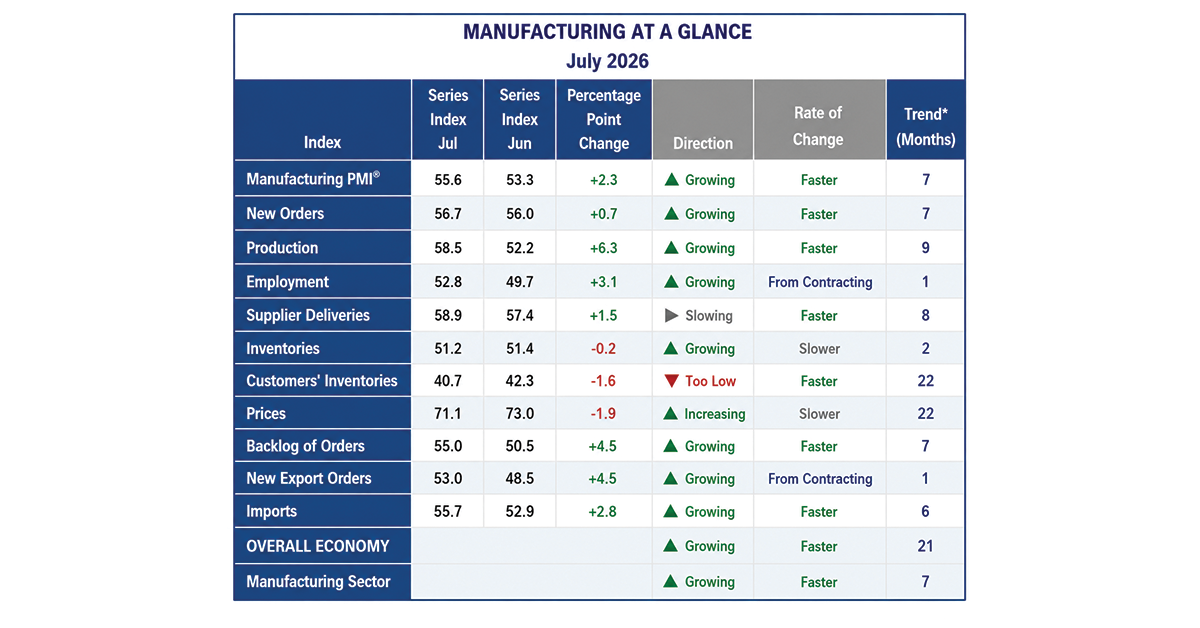
“The New Orders Index expanded for the seventh consecutive month after four straight readings in contraction, registering 56.7%, up 0.7 percentage point compared to June’s figure of 56%,” continues Spence, and emphasizes these highlights:
- The July reading of the Production Index (58.5%) is 6.3 percentage points higher than the 52.2% recorded in June and the highest figure since November 2021 (60.5%).
- The Prices Index remained in expansion (or ‘increasing’ territory), registering 71.1%, a 1.9-percentage point decrease from June’s reading of 73 percent.
- The Backlog of Orders Index registered 55%, up 4.5 percentage points compared to the 50.5% recorded in June. The Employment Index reading of 52.8% is up 3.1 percentage points from June’s figure of 49.7%, putting the index in expansion territory for the first time in 33 months.
- The Supplier Deliveries Index indicated slowing performance for the eighth month in a row after one month in ‘faster’ territory. The reading of 58.9% is up 1.5 percentage points from its June reading of 57.4 percent. (Supplier Deliveries is the only ISM® PMI® Reports index that is inversed; a reading of above 50% indicates slower deliveries, which is typical as the economy improves and customer demand increases.
- The Inventories Index registered 51.2%, down 0.2 percentage point compared to June’s reading of 51.4%. The Customers’ Inventories Index reading of 40.7% is 1.6 percentage points lower compared to the 42.3 percent recorded in June.
- The New Export Orders Index returned to expansion territory with a reading of 53%, 4.5 percentage points higher than the 48.5% registered in June. The Imports Index registered 55.7 percent, 2.8 percentage points higher than June’s reading of 52.9%.
“In July, U.S. manufacturing activity remained in expansion territory, growing at its fastest rate in more than four years,” says Spence. “Of the five subindexes that make up the PMI®, four grew faster compared to the previous month; the exception was the Inventories Index, which was down just 0.2 percentage point.”
“In July, 38% of the comments were positive and 62% negative, with a 1-to-1.6 ratio of positive to negative sentiment,” she concludes. “Pricing volatility was mentioned in 57% of negative comments, the Iran war 43%, increasing lead times 22% and tariffs 18%.”
In July, three of four demand indicators were in expansion (the New Orders, Backlog of Orders and New Export Orders indexes), while the Customers’ Inventories Index remained in ‘too low’ territory, contracting at a faster rate. A ‘too low’ status for the Customers’ Inventories Index is usually considered positive for future production.
“Regarding output, the Production Index expanded for the ninth month in a row, and the Employment Index increased 3.1 percentage points to enter growth territory for the first time in 33 months,” says Spence. “Sixty percent of panelists reported their companies are hiring, while 40% indicated that managing head counts remains the norm.”
The July Index notes that inputs were mixed (defined as supplier deliveries, inventories, prices and imports), with the Supplier Deliveries Index increasing 1.5 percentage points. The Inventories Index declined 0.2 percentage points but remaining within expansion, and Prices Index relief is continuing with the third straight month-over month decrease, to 71.1% compared to 73% in June.
“Looking at the manufacturing economy, 20% of the sector’s gross domestic product (GDP) contracted in July, compared to 5% in June,” says Spence. However, no share of manufacturing GDP was in strong contraction (defined as a composite PMI® of 45% or lower), compared to 3% in June. The share of sector GDP with a PMI® at or below 45% is a good metric to gauge overall manufacturing weakness. It is worthy to note Food & Beverage is among the largest manufacturing industries that expanded in July.
The Shippers Solution: Prioritize Operational Efficiencies, Digital Optimization
While employment has improved and new orders remain healthy, many food companies are prioritizing operational efficiency, automation, and digital optimization over major capital expansion to protect margins. A few examples:
Nestlé, a major global food manufacturer, is focusing its growth strategy on investing in its largest and most strategic consumer platforms rather than individual products, using deep consumer insights to build long-term innovation pipelines that drive sustained organic growth. The company is pairing innovation with stronger marketing capabilities to scale successful ideas across its global brands. At the same time, Nestlé is actively managing its portfolio by regularly evaluating each business's competitive performance and growth potential, taking a disciplined, data-driven approach to improve or reposition underperforming businesses while concentrating resources on its strongest growth opportunities.
 “As we reshape our culture, we are also transforming our business,” says Philipp Navratil, CEO of Nestlé. “We need an efficient, effective organization that enables us to work better, smarter and faster with lower costs. We are simplifying our structure, clarifying roles and reducing duplication across the Group. While this will result in some headcount reductions, we are committed to handling these changes with the utmost respect and transparency, supporting affected employees throughout the process.”
He notes that these steps are necessary to create a leaner, more agile organization by the end of 2027 - one that is better able to digitalize its operations, automate its processes, embed AI and other new technologies, and fully leverage its shared services.
Cargill positions its success around orchestrating a complex global manufacturing and supply chain network that connects farmers, production facilities and customers. The company is consistently focused on four areas to ensure its manufacturing success:
- Building resilient supply chains through strategic investments in processing plants, storage capacity, transportation and logistics infrastructure.
- Connecting the entire food value chain, from farmers to manufacturers to customers, as a core competitive advantage.
- Investing in frontline manufacturing and supply chain employees, recognizing people as essential to operational excellence and resilience.
- Driving innovation in manufacturing and logistics to create a more efficient, sustainable and reliable global food system.
 "We'll keep investing in our supply chains to help ensure a food-secure future, connecting farmers to markets and customers to the supply they need to feed and fuel the world,” says Brian Sikes, Board Chair and CEO of Cargill.
Other recent examples of food manufacturers prioritizing operational efficiencies, digital optimization, and supply chain strategies to continue to power growth in manufacturing include:
- Kraft Heinz: New Global Operating Structure to Accelerate Growth
- PepsiCo Agrees to Deploy More Autonomous Freight through Gatik Partnership
- Case Study: How Orgain Cut Shipping Costs by 22%
- Mars to Invest $2B Into U.S. Manufacturing, Supply Chain through 2026
- WK Kellogg Working On Its Supply Chain Modernization
- Anheuser-Busch Investing $7.4M in Los Angels Brewery
- Nestle Opens State-of-the-Art Beverage Factory and DC in Arizona
- Campbell Soup: Supply Chain Optimization Plan to Fuel Growth
- Supply Chain Harmonization at General Mills
- Perspectives by Bob Costello: Economics Impact on Supply Chains
- Eyes on Every Shipment: What’s Driving Supply Chain Visibility
- Tech-Focused Providers Drive New Value Across Supply Chains
- Top Trucking Challenges Identified by ATRI
For food shippers, success will depend on leveraging technology and process improvements to operate more efficiently rather than simply expanding capacity. Investing in automation, data-driven decision-making, and supply chain optimization will help manufacturers remain agile, control costs, and better meet evolving customer demands.
Related Articles:
- Perspectives by Bob Costello: Economics Impact on Supply Chains
- Eyes on Every Shipment: What’s Driving Supply Chain Visibility
- Tech-Focused Providers Drive New Value Across Supply Chains
- Top Trucking Challenges Identified by ATRI
Like this kind of content? Subscribe to our "Food For Thought" eNewsletter!

Now more than ever, professionals consume info on the go. Distributed twice monthly, our "Food For Thought" e-newsletter allows readers to stay informed about timely and relevant industry topics and FSA news whether they're in the office or on the road. Topics range from capacity, rates and supply chain disruption to multimodal transportation strategy, leveraging technology, and talent management and retention. Learn More