
by Staff, on Jun 23, 2026
As food supply chains face ongoing pressures, from labor shortages and rising transportation costs to growing consumer expectations for freshness and visibility, third-party logistics providers (3PLs) and trucking companies are increasingly turning to technology to create value for their customers.
What was once a business centered primarily on moving freight from point A to point B has evolved into a technology-enabled service that delivers real-time visibility, predictive insights, and greater operational efficiency.
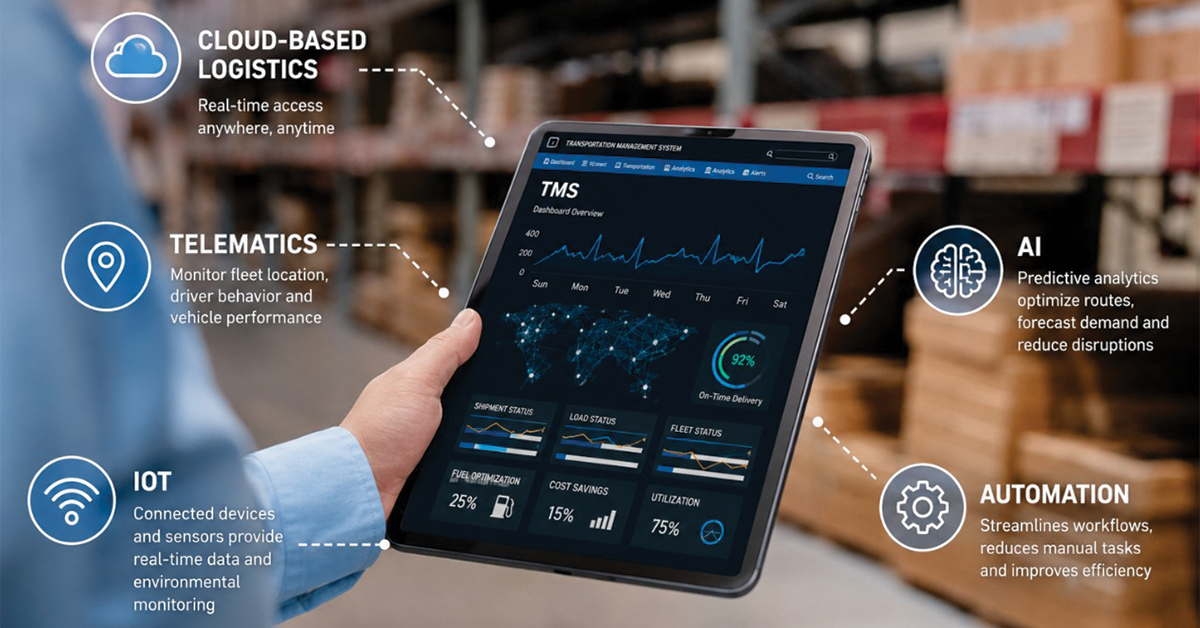
Companies such as Kraft-Heinz, Fresh Del Monte, Tyson, and Happy Egg are strong examples of food shippers leveraging a logistics partner’s technology platform — not just trucks and warehouses — to improve supply chain performance. Providers are bringing value to shippers in a number of areas, including TMS and cloud-based logistics tech, telematics, IoT, AI and automation.
TMS and Cloud-Based Logistics Tech
One of the most significant advancements has been the adoption of transportation management systems (TMS) and cloud-based logistics platforms. These tools allow food manufacturers, distributors, and retailers to monitor shipments in real time, optimize routes, and manage transportation networks more effectively. By providing visibility into shipment status and estimated arrival times, logistics providers help customers reduce inventory uncertainty and improve service levels.
For example, Canadian-based logistics and trucking services provider Flashbee Logistics brings value through shipment tracking and execution, route and carrier selection, mode optimization using historical and real-time data, centralized data capture for cost transparency and performance management, and freight auditing and analytics-driven decision-making.
As an orchestration platform, Bitfreighter automates and coordinates the entire lifecycle of a shipment — from quoting all the way through to invoicing — giving operations teams with food shippers and trading partners superpowers and freeing them to focus on higher-value tasks.
"Food shippers operate in an environment where timing is everything," says Brad Perling, Managing Partner of Bitfreighter. "The biggest challenges I see are a lack of visibility, too much manual work, and disconnected systems that don’t communicate with one another. When a shipment is delayed, product can spoil, shelves can sit empty, and costs can add up quickly. Technology platforms are helping by connecting systems together, automating workflows, and making information available in real time. The right technology is eliminating manual touches, reducing errors, like (tonus) and helping shippers and logistics providers make better decisions so the teams can focus on exceptions."
What are some of the major trends taking place in this area?
"The biggest trend I see is the move toward automation and real-time connectivity," says Perling. "So many companies have such a small percentage of real connectivity. Companies in supply chain need their technology to drive real ROI early, which is why so many have delayed implementing tech because of failed implementations. Having a well connected network is the backbone of supply chain that drives efficiency. This is why we see so many fortune 100 food shippers require EDI and score their logistics companies so heavily on their EDI performance."
"EDI is not going away anytime soon," he continues. "It’s the most widely adopted standard our industry has ever agreed on and it continues to move billions of transactions every year. What I see happening is EDI and APIs working together. The future isn’t EDI versus APIs, it’s EDI data being consumed and communicated through modern API frameworks. The food shippers that win when adopting connectivity will be the ones that make legacy and modern technology work seamlessly together and can accelerate their connections to get to vast and wide connected network."
Telematics Systems and IoT
For temperature-sensitive food products, technology has become especially critical. Telematics systems and Internet of Things (IoT) sensors now enable carriers to continuously monitor trailer temperatures, humidity levels, and equipment performance throughout transit. Automated alerts can notify drivers and dispatchers of potential issues before product quality is compromised, helping reduce spoilage and food waste.
TradeCafe, a trade and fulfillment platform for the protein commodity industry, has highlighted how a lack of shared, real-time information can create costly mistakes in food supply chains. By digitizing data and connecting supply chain participants on a common platform, TradeCafe helps reduce errors that can lead to shipment delays, product loss, or spoilage.
Artificial Intelligence and Automation
Artificial intelligence (AI) and advanced analytics are also playing a growing role. Many logistics providers use predictive tools to anticipate delays caused by weather, traffic congestion, or capacity constraints. These systems can recommend alternative routes or transportation options, allowing food companies to maintain product flow and avoid costly disruptions.
Automation of processes is also a key benefit to technology. For example, Dynamic Logistix emphasizes automation to reduce labor-intensive logistics tasks. Food shippers can automate order entry, shipment tracking, load rework, reporting, and carrier communications through X.TMS. Dynamic Logistix has seen load rework time dropping from roughly 30 minutes to less than three minutes, while carrier status checks can be reduced from about 10 minutes per shipment to under one minute.
Penske Logistics leverages a combination of connected vehicle technology, transportation management systems, supply chain visibility platforms, AI-driven analytics, and warehouse automation to help food shippers improve efficiency, reduce costs, and maintain product quality throughout the supply chain.
Becoming Partners in Shippers Tech Stack
Perhaps most importantly, technology is enabling logistics providers to become strategic partners rather than transactional service providers. By combining transportation expertise with data-driven insights, 3PLs and trucking companies are helping food businesses make better decisions about inventory placement, network design, and transportation planning.
As the food industry continues to navigate economic uncertainty and changing consumer demands, technology-enabled logistics services are becoming a key competitive advantage. For many food shippers, the value of a logistics partner is no longer measured solely by transportation rates, but by the intelligence, visibility, and resilience they bring to the supply chain.
Related Articles:
- Emerging Trends in Supply Chain Visibility
- Tech-Driven Strategies that Manage Change
- Inside the Modern Supply Chain
- Five Best Practices by Food Shippers to Enhance Your Supply Chain
- Supply Chain Transparency: Leveraging Technology to Achieve the Perfect Shipment
Like this kind of content? Subscribe to our "Food For Thought" eNewsletter!

Now more than ever, professionals consume info on the go. Distributed twice monthly, our "Food For Thought" e-newsletter allows readers to stay informed about timely and relevant industry topics and FSA news whether they're in the office or on the road. Topics range from capacity, rates and supply chain disruption to multimodal transportation strategy, leveraging technology, and talent management and retention. Learn More