
by Brian Everett, on Sep 08, 2026
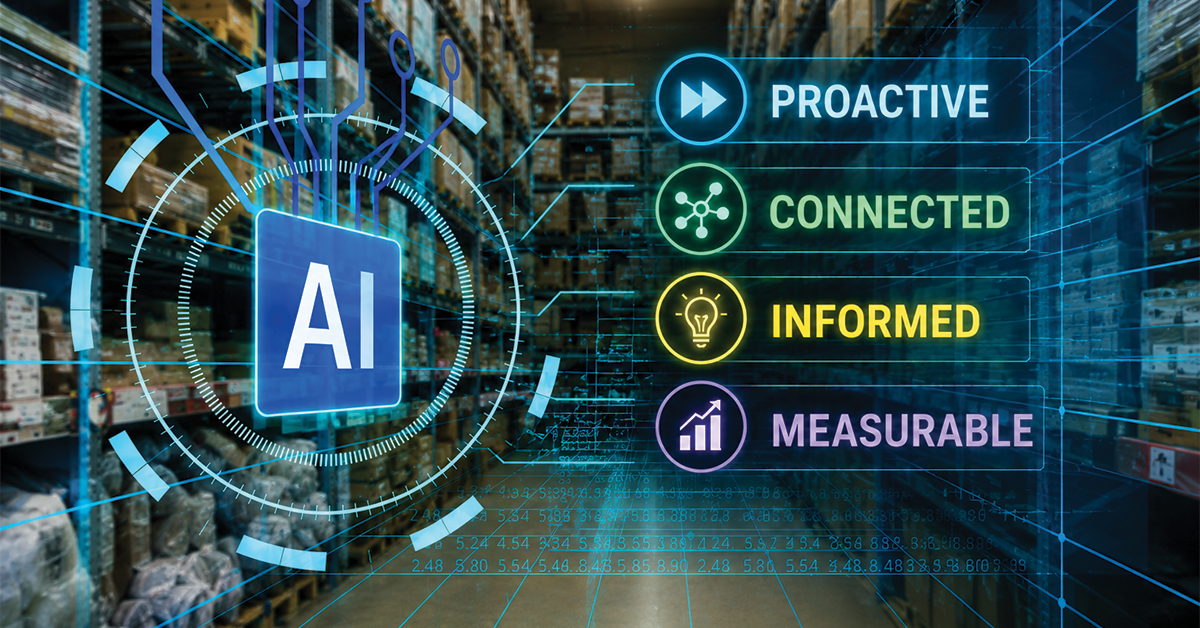
Food companies are quickly shifting artificial intelligence (AI) beyond experimentation to a practical tool that can manage their increasingly complex supply chains. Recent initiatives from leading brands, including PepsiCo, Nestlé, Kraft Heinz, Cargill, Conagra Brands and General Mills, reveal several common principles in how leading food companies are putting AI to work. All of these companies currently are members of Food Shippers of America (FSA).
1. Move From Reactive to Predictive Decision-Making
One predominant theme is the shift from reactively responding to supply chain problems after they occur to anticipating them. Predictive AI and machine learning can analyze enormous volumes of operational and historical data to identify supply chain patterns, forecast customer demand, and predict potential disruptions.
Recent Food Shipper Case Study: Kraft Heinz is leveraging AI-powered predictive demand and inventory management as part of its business goal to accelerate supply chain innovation as part of its broader digital transformation. The company’s control tower uses Azure AI, IoT and analytics to provide visibility into plant operations and automate supply-chain distribution. Ultimately, the food manufacturer is using predictive analytics to improve inventory transparency and anticipate consumer and channel demand.
2. Connect Data Across the End-to-End Supply Chain
AI becomes considerably more valuable when companies break down traditional information silos. Rather than independently optimizing manufacturing, inventory, transportation and procurement, food shippers are increasingly looking at how AI can connect decisions across the entire supply chain.
Recent Food Shipper Case Study: Building on years of integration of AI, automation and machine learning, Nestlé uses AI technology throughout its business, from supply chain through to marketing and consumer engagement. The company’s goals in using AI are to further increase productivity, improve decision-making, and create more value. This is supported by a digital 'backbone' at Nestlé: a single Enterprise Resource Planning (ERP) system and strong data foundations.
What has strengthened the food manufacturer’s ability to accomplish its AI usage goals? Nestlé was recently selected to join the Frontier Firm AI Initiative, a collaboration with D^3 Institute at Harvard and Microsoft
 According to Chris Wright, Chief Information Officer at Nestlé, "AI isn't a pilot at Nestlé; it's already at work from farm to fork. AI helps us get ideas to market faster, optimize recipes, provide trusted nutrition and recipe advice, and create content for our digital channels. We use it to analyze supplier contracts and to sharpen planning, forecasting, and logistics. In our factories, digital twins are driving efficiency and sustainability every day. The key to success? Anchor AI in business needs, equip people with the right skills and intuitive tools, and build on unmatched tech and data foundations. That's how we keep raising the bar for what's possible for the benefit of our consumers, customers and employees."
Nestlé continues to accelerate its digital transformation, rooted in business needs and focused on a comprehensive end-to-end overhaul of how work gets done. By reimagining operating models and leveraging automation, AI, and data-driven decision-making, Nestlé empowers teams to work smarter and faster across the entire value chain.
A few examples of how AI is already making a difference at Nestlé:
- In procurement, Nestlé is applying AI analysis to the contract base of its suppliers. Many suppliers cover multiple markets, and AI enables the review of hundreds of thousands of contracts for inconsistencies between global contract terms and local application in markets, saving time and money.
- Nestlé is evolving digital and automation across its global network of more than 300 factories, using AI for energy, asset, and performance optimization and food safety surveillance.
3. Model Decisions Before Making Them
AI also is changing how food companies evaluate potential operational decisions.
Recent Food Shipper Case Study: When it comes to using AI, Cargill is asking itself this key question: What if Agriculture’s Biggest Challenge Isn’t Producing Enough Food, but Making Sure it Reaches Everyone, in the Right Way at the Right Time?
 To get there, Cargill looks at the potential of AI not through the lens of “just more production,” but rather through smarter movement, stronger connections and deeper trust at every link in the supply chain, says Brian Sikes, CEO: “This will require a different kind of approach—one that can hold complexity, offer clarity and move with speed and scale to help the world’s farmers, customers and communities find their footing in systems under pressure.”
For example, Cargill is using AI to model supply chain decisions before acting, including simulating the flow of barges and trucks to optimize port operations, inventory planning and transportation efficiency.
Recent Food Shipper Case Study: PepsiCo is combining AI with digital twins to create virtual representations of facilities and supply chain operations. This enables teams to simulate changes to equipment, conveyors, pallet movements and workflows before investing money or disrupting physical operations.
 In addition, PepsiCo and Siemens are digitally transforming select U.S. manufacturing and warehouse facilities by converting them into high-fidelity 3D digital twins that simulate plant operations and the end-to-end supply chain to establish a performance baseline, according to Athina Kanioura, Global Chief Strategy & Transformation Officer with PepsiCo. Within a matter of weeks, teams now can validate new configurations to boost capacity and throughput, giving PepsiCo a unified, real-time view of operations with flexibility to integrate AI-driven capabilities over time. This is accomplished as PepsiCo Announces Industry-First AI and Digital Twin Collaboration with Siemens and NVIDIA.
4. Give People Better Intelligence — Not Simply Replace Them
Many of these applications aren't about removing people from supply chain management. They're about giving planners, plant operators, procurement professionals and logistics teams better information and faster insights.
Recent Food Shipper Case Study: General Mills continues a major supply chain transformation by applying AI to real-time manufacturing and end-to-end supply chain optimization. In its July 2026 year-end announcement, the company said it is redesigning its supply chain network and streamlining business processes as part of a broader effort targeting $3 billion in cost savings by fiscal 2030. It expects at least $750 million in savings during fiscal 2027.
General Mills is applying AI to real-time manufacturing data to track raw materials through each stage of production. Machine-learning models then convert that data into insights that allow plant operators to make near-real-time adjustments to system performance and help engineers identify root causes of operational problems. The company says its digital infrastructure also enables real-time analytics across its end-to-end supply chain and helps reduce finished-goods waste.
5. Tie AI to Measurable Business Outcomes
The strongest corporate AI initiatives aren't pursuing the technology simply because it's new. They're connecting it to specific operational objectives: greater throughput, lower costs, improved service, less waste, better inventory management and increased supply chain resilience.
Recent Food Shipper Case Study: PepsiCo strengthens its digital foundation to help teams move from insight to action more quickly and consistently at scale. The company is working to transform its existing IT technology ecosystem and advance the company’s multi-cloud strategy to leverage the best available AI technology to address complex business challenges, such as supply chain management and go-to-market execution.
“As market dynamics and customer expectations evolve, PepsiCo is re-examining how we bring products to market and how we make decisions at scale,” says Kanioura. “Google Cloud’s deep expertise in AI and engineering strengthens our best-in-class supply chain and go-to-market capabilities — giving us unprecedented speed and precision to model scenarios that were previously impossible to run. The result is faster decisions, improved frontline experiences, and a step change in how we design and operate our business.”
Through the collaboration, PepsiCo is using Gemini Enterprise Agent Platform to strengthen its foundational capabilities across three primary pillars: Scaling global intelligence, optimizing the value chain, and empowering its workforce.
Recent Food Shipper Case Study: Conagra Brands has placed technology and AI alongside strategic sourcing, process improvement and network optimization as levers for improving supply chain performance. Ultimately, the lesson emerging from these food companies is that AI itself isn't the strategy.
The real opportunity lies in applying AI to clearly defined supply chain problems where better prediction, greater visibility, faster analysis and more informed decisions can generate measurable results. Ultimately, Conagra Brands is connecting AI not simply to consumer analytics, but directly to end-to-end supply chain transformation, procurement, manufacturing, logistics, warehousing and cost reduction. Through AI strategies, Conagra Brands is Winning the Battle for Superior Relative Provocativeness.
Related Articles:
- Generative AI Transforming Food Supply Chains, One Decision at a Time
- AI-Empowered: From Planning to Operations and Risk Management
- Amazon’s Latest AI and Robotics Boost Efficiency and Accelerate Deliveries
- AI-Powered Automated Counting Creates Efficiencies
- Nestle Leverages AI and Automation to Increase Speed, Consumer Focus
- How Unilever is Leveraging AI to Transform its Ice Cream’s Supply Chain
Like this kind of content? Subscribe to our "Food For Thought" eNewsletter!

Now more than ever, professionals consume info on the go. Distributed twice monthly, our "Food For Thought" e-newsletter allows readers to stay informed about timely and relevant industry topics and FSA news whether they're in the office or on the road. Topics range from capacity, rates and supply chain disruption to multimodal transportation strategy, leveraging technology, and talent management and retention. Learn More