
by Brian Everett, on Nov 24, 2026
Predicting consumer demand has never been simple for food manufacturers, retailers and their supply chain partners. However, shifting consumer preferences, economic uncertainty, promotional activity and increasingly complex shopping behaviors are making accurate forecasting more challenging than ever. Traditional forecasting methods that rely heavily on historical sales data are no longer sufficient in an environment where demand can shift quickly and unexpectedly.
To stay ahead, food shippers are embracing more sophisticated, data-driven approaches to demand forecasting. Artificial intelligence (AI), real-time market intelligence, more granular demand models and closer collaboration across supply chain partners are transforming how companies anticipate consumer needs. These emerging trends are helping food shippers make smarter production and inventory decisions, improve product availability, minimize waste and build more responsive, resilient supply chains.
Food Shippers React to Main Forecasting Trends
Here are several trends that are reshaping demand forecasting, along with food companies that are leading the way in responding to these trends for exemplary demand forecasting practices.
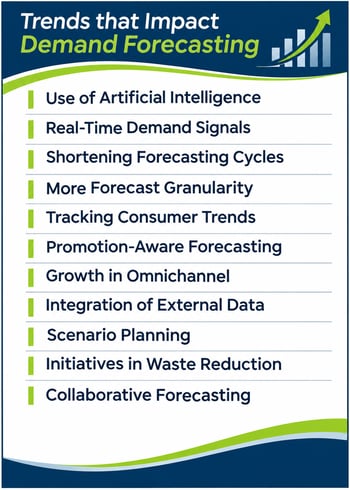
AI-Powered Forecasting: Food companies are using AI and machine learning to analyze larger datasets and identify demand shifts faster than traditional forecasting models.
Hormel Foods, a member of FSA, recently announced it had implemented an AI-powered planning platform to improve forecasting accuracy, anticipate seasonal demand, and strengthen supply chain operations.
 “Every day, we balance moving thousands of products across multiple channels and storage environments,” says Will Bonifant, Hormel Foods’ Chief Supply Chain Officer in a recent news release (Photo Courtesy: Hormel Foods). “By connecting demand, supply, and inventory decisions in one streamlined platform, we are shifting from reactive problem-solving to more proactive, data-driven planning. We believe this will strengthen our ability to operate consistently, serve customers more reliably, and ultimately, drive additional growth across our brand portfolio.”
Real-Time Demand Signals: Companies increasingly incorporate current sales, inventory, weather, promotions and other near-real-time data rather than relying primarily on historical sales.
PepsiCo, an FSA member, is incorporating current market information into its decision-making rather than relying exclusively on historical sales.
“Retail is becoming more complex, with shoppers moving across more channels, occasions and store formats,” says Miguel Suadi, Senior Vice President, International Commercial, PepsiCo in a recent corporate article, Helping Retailers Shape the Future of the Shopper Experience. “We need a connected ecosystem that brings together customer and shopper insight, advanced analytics and the experience of our frontline teams so we can turn complexity into practical actions that work for each retail environment and create value for our customers and shoppers.”
Shorter Forecasting Cycles: Rapidly changing consumer behavior is pushing companies toward more frequent forecasts and continuous demand planning.
For example, Unilever sees that consumer demand cycles have shortened dramatically, requiring it to make faster decisions about production, inventory and replenishment.
 Vicky Cuthbert, Chief Product Supply Chain Officer for Personal Care with Unilever, explains in a recent corporate article what’s involved in ensuring the company’s brands are available wherever and whenever consumers want them, especially during a global retail activation like the FIFA World Cup 2026 (Photo Courtesy: Unilever).
Greater Forecast Granularity: Forecasts are becoming more specific by SKU, store, region, channel and customer segment to better reflect localized demand.
The Hershey Company, for example, described in a recent article how (“How Hershey’s People and Technology Bring Hersheyween to Life”) it combines store-level analytics, image recognition technology and local market intelligence to monitor inventory trends and consumer purchasing patterns across more than 75,000 U.S. retail locations. These capabilities help Hershey and its retail partners identify product availability issues, refine seasonal assortments and respond more quickly to demand fluctuations at individual stores.
Consumer Trend Tracking: Social media, search activity and consumer research are being used to anticipate emerging preferences such as high-protein, functional and minimally processed foods.
Nestlé specifically documents how it combines consumer research, online search behavior, menu trends, retail sales data and consumer conversations to anticipate emerging food preferences. In October 2026, Nestlé USA released its 2027 Food and Beverage Trend Forecast, identifying five emerging shifts in consumer preferences. The company continuously monitors thousands of early consumer signals annually to identify trends that could influence future product development and purchasing behavior.
Promotion-Aware Forecasting: More sophisticated models account for promotions, pricing changes and retailer activity that can dramatically alter short-term demand.
In June 2026, PepsiCo researchers published details that involved PromoAI, which combines machine learning-based promotional forecasts with optimization technology to evaluate millions of combinations of products, promotions and timing. The system helps PepsiCo develop promotional calendars that maximize revenue for both PepsiCo and its retail partners. See published piece: “PepsiCo Deploys AI-Driven Pricing and Promotion Optimization at Scale.”
Omnichannel Forecasting: Companies are developing forecasts that distinguish among in-store, pickup, delivery and direct-to-consumer demand.
In this article “Inside the AI Network Orchestrating Walmart’s Fastest Holiday Deliveries Yet,” Walmart described how its AI-powered supply chain technology supports increasingly complex shopping and fulfillment patterns.
External Data Integration: Weather, economic conditions, commodity prices, holidays and local events are increasingly incorporated into demand models.
SLA, an organic meat producer, recently implemented Qlik Predict, an AI-powered predictive analytics platform, to improve forecasts for its organic meat production. Rather than relying exclusively on historical sales, the company incorporates weather conditions that influence purchasing patterns, holidays that affect seasonal demand, store sizes that help distinguish purchasing volumes, and geographic delivery locations that reflect regional demand differences.
Read “AI Cuts Forecasting Errors to 1% at Major Producer.”
Scenario Planning: Rather than relying on a single forecast, companies are modeling multiple demand scenarios to prepare for economic and supply-chain uncertainty.
Because demand for production and distribution capacity is increasing, PepsiCo recently announced it now is using AI and new digital approaches to process simulation and facility design to retool and optimize its existing physical footprint.
 "The scale and complexity of PepsiCo’s business, from farm to shelf, is massive—and we are embedding AI throughout our operations to better meet the increasing demands of our consumers and customers,” says Ramon Laguarta, Chairman and CEO of PepsiCo (Photo Courtesy: PepsiCo). The company recently announced an industry-first AI and Digital Twin Collaboration with Siemens and NVIDIA.
Waste Reduction: Better forecasting is increasingly tied to reducing spoilage and excess inventory, particularly for fresh and perishable foods.
Albert Heijn, the Netherlands' largest supermarket chain, is using AI and machine learning to forecast demand at the individual-product and store level. As part of this initiative, waste reduction is being accomplished by the grocery retailer directly connecting AI-powered demand forecasting with reducing excess inventory, spoilage and food waste.
 The first step in preventing food waste is always to stock the stores as closely as possible with what people want to buy,” says Noortje van Genugten, Vice President, Product Core Retail for the company. “AI is helping us do that. We’re currently rolling out new algorithms that use AI assortment planning, to determine the correct product mix per store and assortment group.
“Secondly, we use AI to forecast customer demand and algorithms to determine how much of a product we should deliver to a store and when – like the production algorithm we use in the bakery app,” she continues. “Because we can never forecast perfectly, we use AI to dynamically mark down the cost of items on the shelves that are about to expire. These dynamic prices are automatically pushed to our Albert Heijn app and the electronic shelf label – the system reevaluates and updates every 15 minutes.”
She outlines her perspectives in the article, “How AI is Empowering Associates, Serving Customers and Driving Sustainability.”
Collaborative Forecasting: Food manufacturers, retailers and supply-chain partners are sharing more data to improve visibility and align production, inventory and replenishment.
For example, Kraft Heinz is connecting its demand-planning systems with retailers' inventory and sales information to improve forecasting accuracy, product availability and replenishment decisions. During its November 2026 Investor Day, Kraft Heinz executives described a pilot program involving U.S. retail customers that connects previously disconnected supply chain information.
Related Articles:
- Demand Forecasting: What’s For Dinner Tomorrow?
- Generative AI Transforming Food Supply Chains, One Decision at a Time
- The Hidden Complexity of Stocking 10,000 SKUs
- Wawa Improves Forecasting, Replenishment to Cut Food Spoilage
- Building Supply Chain Resiliency (and Fixing Top Challenges)
Like this kind of content? Subscribe to our "Food For Thought" eNewsletter!
Now more than ever, professionals consume info on the go. Distributed twice monthly, our "Food For Thought" e-newsletter allows readers to stay informed about timely and relevant industry topics and FSA news whether they're in the office or on the road. Topics range from capacity, rates and supply chain disruption to multimodal transportation strategy, leveraging technology, and talent management and retention. Learn More