
by Brian Everett, on Oct 27, 2026
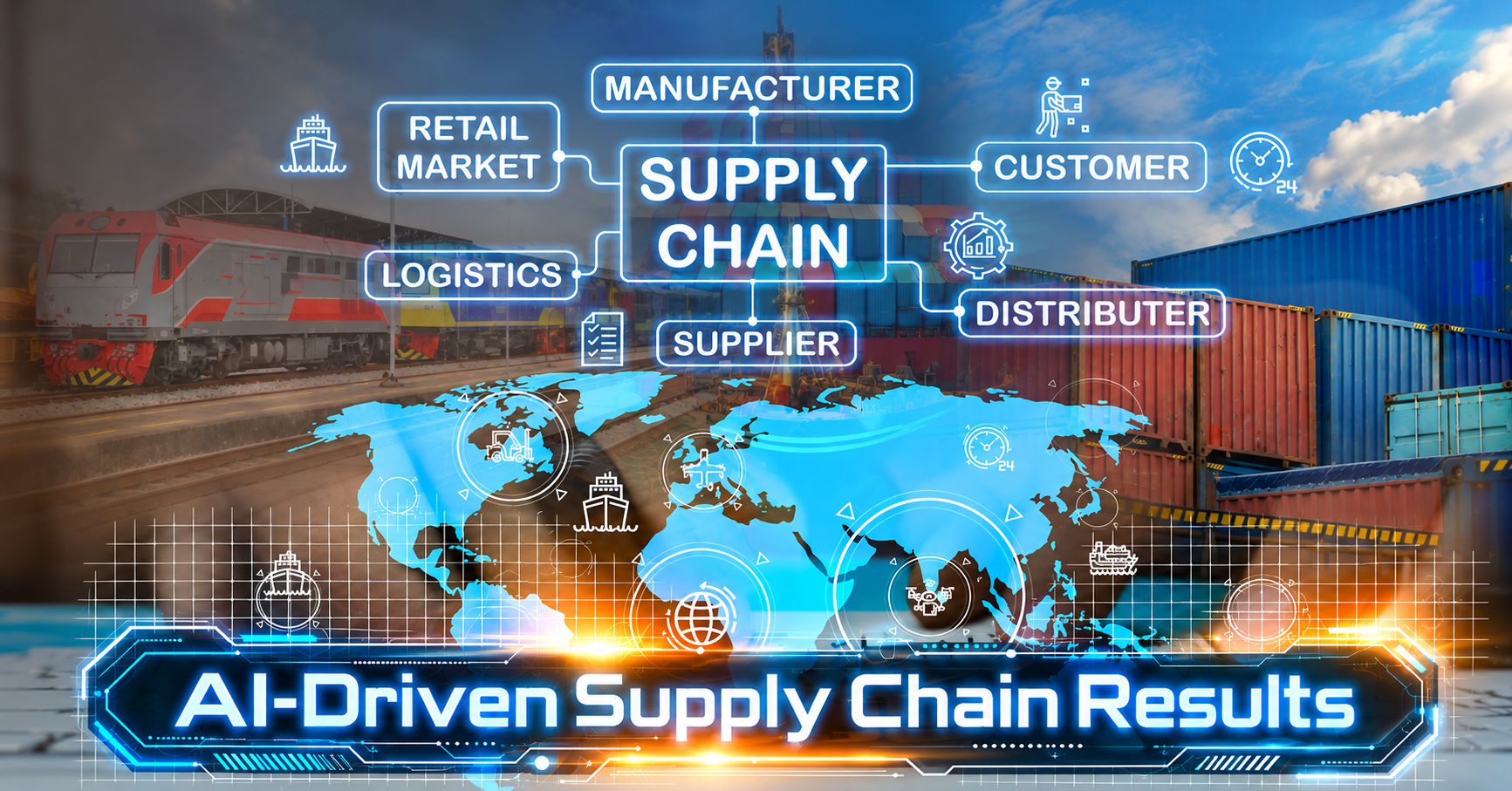
Artificial intelligence (AI) is rapidly changing how food companies plan, manage and execute their supply chain operations. What began as an opportunity to analyze enormous volumes of information is evolving into something much more powerful: Technology that helps food companies optimize resources, anticipate disruptions, and make operational decisions faster and more accurately.
For food manufacturers, retailers, and their logistics partners, the potential extends throughout the supply chain. AI-powered tools are improving demand forecasting, identifying inventory imbalances, optimizing transportation routes, accelerating quality inspections and helping manufacturers evaluate operational changes before making costly investments. Perhaps most importantly, leading food shippers are beginning to demonstrate tangible results.
From PepsiCo's AI-powered digital twins to Kroger’s use of high-tech to improve forecasting, operational efficiency and customer experiences, food companies are finding ways to translate business data and intelligence into supply chain excellence.
PepsiCo: Using Digital Twins to Increase Throughput and Reduce Costs
Beverage manufacturer and marketer PepsiCo, a member of Food Shippers of America (FSA), is taking an innovative approach to AI by creating virtual replicas of manufacturing plants and warehouses to identify opportunities for greater efficiency.
In January 2026, the global food and beverage company announced a multiyear collaboration with Siemens and NVIDIA to transform plant and supply chain operations through advanced digital twin technology and artificial intelligence. This collaboration marks a first-of-its-kind initiative for a global CPG company applying digital twins to reshape how plant and warehousing facilities are digitally simulated and tested, with early pilots already underway in the U.S.
Rather than relying exclusively on traditional facility expansion, PepsiCo is using AI-powered simulations to evaluate how existing facilities can accommodate additional production and distribution capacity. The technology digitally recreates machinery, conveyors, pallet movements and employee pathways, allowing teams to simulate operational changes before implementing them.
According to PepsiCo, early deployments have produced measurable results:
- 20% increase in throughput during initial deployment and is driving faster design cycles
- 10% to 15% reduction in capital expenditures through more effective facility planning
- Up to 90% of potential operational issues identified before physical modifications
- Nearly 100% design validation in the company's early applications.
This AI-powered technology allows PepsiCo to evaluate different configurations, identify operational bottlenecks and optimize facility layouts without disrupting existing operations.
 "The scale and complexity of PepsiCo's business, from farm to shelf, is massive," says Ramon Laguarta, Chairman and Chief Executive Officer of PepsiCo, emphasizing the company's commitment to incorporating AI throughout its operations.
 “We are deploying the first digital blueprint that reimagines how the supply chain is designed, built, and scaled, a first for the industry,” says Athina Kanioura, PepsiCo's CEO of Latin America and Global Chief Strategy & Transformation Officer. She described the company's long-term vision as creating an intelligent ecosystem in which manufacturing and distribution facilities can anticipate and adapt to changing demand.
PepsiCo's experience demonstrates how AI can improve the economics of food supply chain expansion by identifying additional capacity within existing infrastructure.
Albertsons: Applying AI to Improve Fresh Produce Quality
AI is helping Albertsons Companies address a particularly challenging aspect of food distribution: maintaining consistent quality standards for highly perishable products. In May 2026, Albertsons announced the introduction of its Intelligent Quality Control tool, an AI-powered solution designed to assist quality inspectors at distribution centers (DCs).
Developed internally with technology support from Google Cloud, the system uses computer vision and AI models to evaluate fresh produce against the retailer's established quality standards. The process begins when an inspector submits an image of produce to the system. AI evaluates visual characteristics and provides a quality rating and recommendation for the inspector's approval. Initially the technology is being used to inspect strawberries as well as red and green grapes. However, future plans include expanding into additional berry categories and eventually other fresh products.
Albertsons identified several operational improvements from its early deployment:
- Increase in rating consistency: The AI-driven evaluation has reduced the variability in quality ratings among different inspectors and shifts at a location, ensuring a more uniform standard.
- Faster decision-making: The automated scoring system accelerates the inspection process, supporting distribution center teams in getting food quickly to stores so that customers consistently receive fresh, high-quality produce.
- Expanded quality data: The solution captures many distinct measures of quality which can be used for ongoing quality analysis and improvement.
- Alignment with standards: The solution successfully applies internal Albertsons quality criteria, with high consistency across all evaluations.
 According to Evan Rainwater, Executive Vice President and Chief Supply Chain Officer at Albertsons, early results demonstrate the technology's ability to improve the consistency of quality inspections. The company views the initiative as part of a broader strategy to improve operational efficiency, product quality and customer satisfaction throughout its supply chain.
For food manufacturers and distributors, this application illustrates how AI can help address product integrity and quality-control challenges that directly affect freshness, waste and customer satisfaction.
Kroger: Connecting Demand Forecasting With Operational Decisions
Kroger is building on its longstanding use of customer data and analytics to expand AI applications across its grocery operations. In September 2026, the retailer outlined an AI strategy that combines customer insights, operational data and proprietary technology models to improve forecasting, operational efficiency and customer experiences.
According to Kroger, its existing AI capabilities include demand forecasting, operational optimization and personalized customer engagement. The company is now expanding these capabilities through systems designed to connect operational information and support faster decision-making.
 Yael Cosset, Executive Vice President and Chief Digital Officer at Kroger, describes this strategy as being built on using AI to improve the customer experience, make work easier for associates and produce better business outcomes.
"This isn't new for Kroger," says Cosset. "We've long been using data science and artificial intelligence to serve our customers by precisely forecasting demand, connecting customers with the most relevant savings opportunities and helping them find and get the products they need. Our latest investments in AI allow us to connect relevant business and operational signals to make decisions and take action faster."
More recently, Kroger has focused on connecting business and operational information so teams can make decisions and take action more quickly. The retailer describes its AI development strategy in three stages:
- Assisted: AI provides information and recommendations that support employee decisions.
- Augmented: AI becomes more deeply integrated into workflows, helping employees perform tasks and make decisions.
- Autonomous: AI can execute selected activities with appropriate oversight and controls.
Kroger emphasizes that not every business process requires full automation.
The company also is developing AI tools to help frontline associates prioritize operational information rather than sorting through numerous daily notifications. Kroger is making AI training and tools available to more than 400,000 associates, reflecting its belief that successful implementation requires workforce readiness alongside technology investments.
Although Kroger has not disclosed specific financial savings from these initiatives, its strategy illustrates how food shippers are connecting AI-powered demand forecasting with broader operational decision-making.
Conagra Brands: Connecting AI With Supply Chain Visibility and Demand Intelligence
For the past few years, FSA member Conagra Brands has been incorporating artificial intelligence into business operations to improve supply chain visibility, demand planning and operational performance. The leading branded food manufacturer has described several AI initiatives, including using complex data systems to better understand consumer preferences and emerging trends. These capabilities help Conagra identify changes in consumption patterns and address demand-related challenges.
The company also has described using AI to track supply chain processes, improve shipment visibility and identify opportunities to prevent product losses.
In December 2025, Conagra announced Project Catalyst, an initiative designed to leverage AI, data and emerging technologies to create additional value throughout its operations.
During its fiscal 2026 second-quarter earnings commentary, the company said its supply chain had achieved record service levels and strong productivity while introducing the initiative. The initiative reflects a broader strategy of connecting technology investments with business processes to strengthen operational efficiency.
For food shippers, Conagra's approach highlights the value of integrating demand intelligence with supply chain visibility, particularly when managing changing consumer preferences and complex distribution networks.
Turning AI Investments Into Measurable Results
PepsiCo, Albertsons Companies, Kroger and Conagra are just a few examples that reveal an important shift in how food shippers are approaching artificial intelligence. Rather than viewing AI primarily as an emerging technology, companies are increasingly applying it to specific operational challenges with clearly defined business objectives.
The results of these companies also illustrate that AI doesn’t need to replace human decision-making to create value. In many applications, its greatest contribution comes from helping employees process information, identify exceptions and make better decisions more quickly.
For food manufacturers, retailers and logistics providers, the next stage of AI adoption will likely focus less on the number of technologies deployed and more on their ability to improve measurable performance. That means evaluating AI investments against practical supply chain metrics: inventory accuracy, forecast reliability, transportation efficiency, warehouse productivity, product quality, operating costs and customer service.
Ultimately, the competitive advantage will come not simply from collecting more data, but from turning supply chain intelligence into faster decisions, more efficient operations and measurable business results.
Related Articles:
- Generative AI Transforming Food Supply Chains, One Decision at a Time
- Sysco Targets $500M in AI-Powered Efficiencies Across Its Operations
- How Unilever is Leveraging AI to Transform Its Ice Cream’s Supply Chain
- AI-Empowered: From Planning to Operations and Risk Management
- Amazon’s Latest AI and Robotics Innovations Boost Efficiency, Accelerate Deliveries
Like this kind of content? Subscribe to our "Food For Thought" eNewsletter!

Now more than ever, professionals consume info on the go. Distributed twice monthly, our "Food For Thought" e-newsletter allows readers to stay informed about timely and relevant industry topics and FSA news whether they're in the office or on the road. Topics range from capacity, rates and supply chain disruption to multimodal transportation strategy, leveraging technology, and talent management and retention. Learn More